
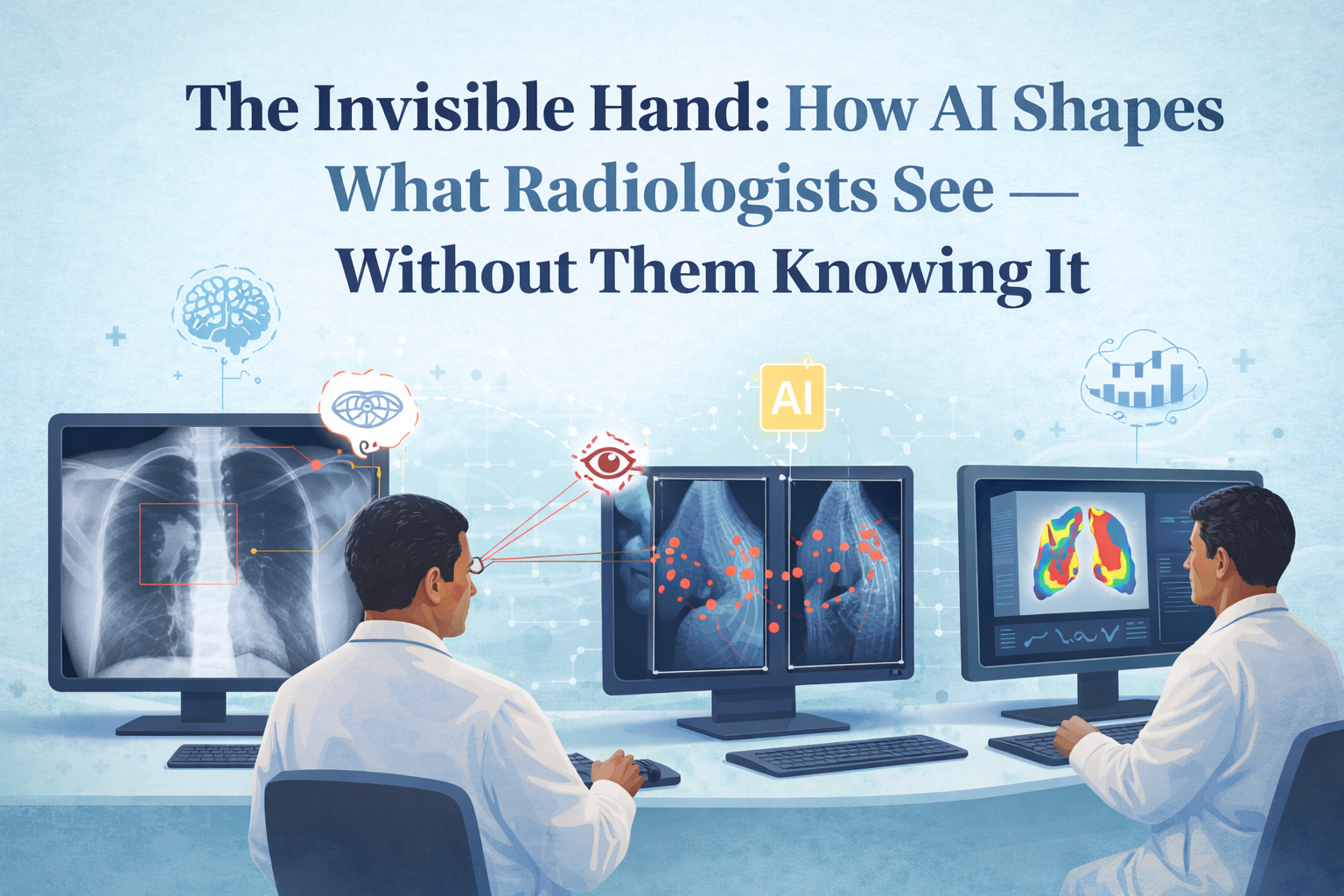
In a previous article on catastrophic AI risk in clinical settings, I noted that research in radiology has documented how AI suggestions sway readers and influence decisions in ways that aren't always visible to the reader themselves. Several readers asked for the evidence behind that claim. This article is that evidence — drawn entirely from research published or presented in the past twelve months.
What the literature shows is more specific, and more concerning, than the general notion of "automation bias." AI doesn't just nudge radiologists toward different conclusions. It physically redirects where they look — altering visual search patterns, dwell times, and lung-field coverage in ways that are measurable by eye tracker but largely invisible to the reader in the moment. The influence isn't felt as influence. It's felt as normal reading.
AI doesn't just change what radiologists decide. It changes what they see in the first place — and what they never get around to looking at.
The Scale of the Problem in 2025–2026
Before examining the mechanism of influence, it's worth establishing context. As of August 2025, 1,247 AI-enabled medical devices have received FDA authorization, with radiology devices comprising more than 75% of approvals. A structured review published in the International Journal of Computer Assisted Radiology and Surgery in November 2025 placed that figure at over 1,200, noting that by 2030, nearly all workflow steps in MRI and CT interpretation are expected to have AI-supported options.
AI decision support is no longer a pilot program. It is the clinical environment. Which means the question of how AI influences reader behavior isn't theoretical — it's happening in thousands of reading rooms right now.
The Eye-Tracking Evidence: AI Rewires Visual Search
The most significant recent development in understanding AI reader influence comes from a new category of research: studies that use eye trackers to observe what radiologists actually look at — not just what they report. Two studies published in 2025 are particularly important.
Published in Radiology, the flagship journal of the RSNA. pubs.rsna.org/doi/10.1148/radiol.243688 →
The Gommers study used an infrared eye-tracking camera positioned in front of the reading workstation to record the exact coordinates of each radiologist's gaze across 150 screening mammography cases — with and without AI decision support. The findings reframe the automation bias discussion entirely.
When AI support was present, radiologists spent significantly more time examining regions that contained actual lesions. When the AI gave a low suspicion score, radiologists moved through cases more quickly — trusting the reassurance signal and reducing their dwell time on normal-appearing tissue. When the AI gave a high score, radiologists returned to those regions for a second, more careful look.
The AI was functionally governing reading behavior in real time — directing attention, rationing scrutiny, and shaping which areas received thorough evaluation. The radiologists didn't experience this as the AI "telling them what to do." They experienced it as reading mammograms.
Gommers noted the clear upside: when AI was accurate, this attention redirection improved detection performance without extending reading time. But she also identified the risk that makes this finding consequential for governance: overreliance on erroneous AI suggestions could lead to missed cancers or unnecessary recalls, and the mechanism through which this happens — altered visual search — would not be apparent to the reader or a supervising clinician reviewing the report.
Preprint submitted October 2025. 180 chest radiographs, 3 radiologists (1, 5, and 11 years experience), 80% display sensitivity/specificity. arxiv.org/abs/2510.20864 →
Matsumoto and colleagues studied the effect of bounding-box highlights — the visual overlays that many AI systems use to indicate suspected findings on chest radiographs. Using eye tracking across 180 cases interpreted both with and without bounding boxes, they found that the display of AI highlights measurably changed every aspect of visual search behavior they could quantify.
Radiologists took longer to interpret cases when bounding boxes were present — not because the AI confused them, but because it drew their attention more thoroughly into the flagged region. They covered more of the lung field overall. They reached the actual lesion location faster. The AI cue functioned as a navigational interrupt that reorganized the entire reading sequence.
The researchers noted this is a double-edged finding: when the AI is right, this reorganization is beneficial. When the AI is wrong — highlighting a benign artifact, missing a subtle finding, or mis-localizing a real abnormality — the same mechanism that improves detection in the best case actively channels attention away from where the problem actually is.
Emergency Medicine: The Same Effect Under Higher Pressure
The eye-tracking studies focus on radiologists under research conditions. A 2025 multi-reader study published in Emergency Medicine Journal examined AI influence in a higher-pressure context: emergency doctors interpreting chest X-rays to inform urgent clinical decisions.
Macquarie University & Royal Prince Alfred Hospital. Multi-reader multi-case study examining AI's effect on emergency doctors' diagnostic decisions for chest X-rays in a simulated clinical vignette environment. Published BMJ Group, Oct 2025.
NIHR-funded UK review covering 8,013 identified studies. Found automation bias repeatedly flagged as a real implementation risk, particularly for non-specialist clinicians who are often the first to interpret imaging in real-world settings.
The Emergency Medicine Journal study noted a known mechanism that shapes how heavily any clinician is influenced by AI: the perceived reliability of the automation. Clinicians tend to be less influenced by decision support they believe is inaccurate. But that corrective instinct only activates when the clinician already suspects the AI may be wrong — which in high-volume ED environments under cognitive load, is not always the case.
The Lancet scoping review, which synthesized 140 studies on AI in radiology diagnostics published between 2020 and 2025, found that automation bias was among the most consistently identified implementation risks — and that it was particularly pronounced for non-specialist clinicians who are frequently the first readers of imaging in real-world environments outside academic medical centers.
The Compounding Problem: AI That Carries Its Own Bias
The mechanism of invisible influence is most dangerous when the AI itself carries systematic bias — because the reader's altered visual search will reliably follow the AI toward its errors rather than away from them.
A May 2025 paper in Radiology, covered by RSNA News, identified key pitfalls and best practices for evaluating algorithmic bias in radiology AI. Lead author Paul H. Yi, MD, director of Intelligent Imaging Informatics at St. Jude Children's Research Hospital, noted that of 23 publicly available chest radiograph datasets reviewed, only 17% reported race or ethnicity — meaning most radiology AI has been trained and evaluated without adequate demographic representation.
The practical consequence: when AI systematically underperforms for a specific demographic subgroup — older patients, racial minorities, patients with atypical presentations — and the reader's visual search is being redirected by that AI in real time, the combination produces a failure mode that is invisible at both levels. The AI didn't flag it. The reader didn't know to look harder. The report looks normal.
- Of 23 publicly available chest radiograph datasets, only 17% reported race or ethnicity (Yi et al., Radiology, 2025)
- AI underdiagnosis rates in chest X-ray classification are higher for racial minority subgroups in multiple large-scale dataset analyses (PMC, AMIA 2025)
- Synthetic data augmentation and oversampling strategies to correct demographic bias have shown limited effectiveness without understanding the mechanism of bias at the acquisition level
- The EU AI Act, taking full effect in 2026, classifies radiology AI as high-risk, requiring documented bias checks, training data curation, and human oversight policies
What This Means for Governance — Practically
The combined evidence from these 2025 studies points to a governance problem that is more specific than "AI might be wrong sometimes." The problem is that AI influence on reader behavior is structural — it operates at the level of visual attention itself — and current clinical workflows have no mechanism to detect, monitor, or account for it.
Validate AI presentation format, not just AI accuracy
The Matsumoto eye-tracking study shows that bounding boxes change reading behavior measurably. Concurrent display, deferred display, and no display produce different search patterns. Health systems deploying AI need to specify — and validate — which presentation format is appropriate for which clinical context. This is a governance decision, not just a UX preference.
Require demographic subgroup performance data from AI vendors
If an AI tool underperforms for specific patient populations, it will redirect visual attention toward incorrect conclusions for those populations — systematically and silently. The RSNA's May 2025 best practices guidance recommends collecting and reporting at minimum age, sex/gender, race, and ethnicity as part of AI validation. Health systems should require this as a procurement condition, not an optional disclosure.
Train radiologists on the mechanism of AI influence, not just the tool
Gommers and colleagues at Radboud identified that radiologists need education on how to critically interpret AI information — specifically including how AI cues alter reading behavior. This is distinct from training on how to use the tool. It requires explicit teaching of the failure modes, with case examples of how AI-redirected attention produces misses that look like normal clinical reads.
Monitor for population-level performance drift, not just case-level errors
Because AI-influenced misses are invisible at the individual case level, they may only be detectable at the population level — through outcomes monitoring, re-read audits, or comparison of AI-assisted read rates against unaided historical performance for specific patient subgroups. This requires the kind of post-market surveillance infrastructure that most clinical AI deployments currently lack entirely.
Consider deferred AI display for high-acuity reads
Both the Matsumoto and Gommers studies design their protocols carefully around when AI information is made available. Deferred display — showing AI output after the reader has completed an initial independent assessment — preserves the reader's unbiased first pass while still providing AI as a safety net. This is not a universal solution, but it is a deployment design choice with real clinical implications that should be made deliberately.
The Governance Gap Is Measurable Now
What 2025's eye-tracking research has given us is something that was previously hard to articulate: a quantifiable mechanism for the invisible influence of AI on radiologist behavior. We can now measure, in pixels and seconds, exactly how AI decision support changes where a reader looks, for how long, and with what consequences for coverage of the image.
That's not a reason for alarm about AI in radiology. It's a reason for precision in how we govern it. The tools work — when they're right. The influence is real — when they're wrong. The gap between those two realities is exactly where governance infrastructure needs to live.
As of 2026, most health systems deploying radiology AI have neither the monitoring frameworks nor the vendor accountability structures to operate in that gap responsibly. That's the problem worth solving.
Are you seeing AI influence reader behavior in your department? Are there workflow designs or governance structures you've found effective? I'd genuinely welcome the conversation. [email protected] →
Sources — All Published Within the Past 12 Months
-
Gommers, J.J.J. et al. "Influence of AI Decision Support on Radiologists' Performance and Visual Search in Screening Mammography." Radiology (RSNA). July 2025.
Jul 2025
pubs.rsna.org/doi/10.1148/radiol.243688 -
Matsumoto, D. et al. "Eye-Tracking as a Tool to Quantify the Effects of CAD Display on Radiologists' Interpretation of Chest Radiographs." arXiv preprint. October 23, 2025.
Oct 2025
arxiv.org/abs/2510.20864 -
RSNA News. "AI Helps Radiologists Spot More Lesions in Mammograms." RSNA Press Release covering Gommers et al. Radiology. July 2025.
Jul 2025
rsna.org/news/2025/july/ai-spots-more-lesions-on-mammograms -
BMJ / Macquarie University et al. "Evaluating the Impact of AI Assistance on Decision-Making in Emergency Doctors Interpreting Chest X-Rays: A Multi-Reader Multi-Case Study." Emergency Medicine Journal. Published October 13, 2025.
Oct 2025
pmc.ncbi.nlm.nih.gov/articles/PMC12703329 -
Linaker, C. et al. "Artificial Intelligence for Diagnostics in Radiology Practice: A Rapid Systematic Scoping Review." eClinicalMedicine (The Lancet). May 2025. (140 studies, 2020–2025.)
May 2025
thelancet.com/journals/eclinm/…PIIS2589-5370(25)00160-9 -
Yi, P.H. et al. "Pitfalls and Best Practices in Evaluation of AI Algorithmic Biases in Radiology." Radiology (RSNA). Covered by RSNA News: "Radiologists Share Tips to Prevent AI Bias." May 2025.
May 2025
rsna.org/news/2025/may/tips-to-prevent-ai-bias -
Thenault, R. et al. "Enhancement of Fairness in AI for Chest X-Ray Classification." AMIA Annual Symposium Proceedings. Published PMC May 2025. (MIMIC-CXR underdiagnosis bias across racial subgroups.)
May 2025
pmc.ncbi.nlm.nih.gov/articles/PMC12099404 -
Pesapane, F., Rotili, A. & Cassano, E. "Artificial Intelligence as Medical Device in Radiology in 2025: The Regulatory Scenario in the EU, USA, and China." European Radiology. March 2026.
Mar 2026
link.springer.com/article/10.1007/s00330-026-12460-4 -
Voss, M. et al. "AI in Radiology and Interventions: A Structured Narrative Review of Workflow Automation, Accuracy, and Efficiency Gains." International Journal of Computer Assisted Radiology and Surgery. November 2025. (1,247 FDA-authorized AI devices as of August 2025, radiology comprising >75%.)
Nov 2025
link.springer.com/article/10.1007/s11548-025-03547-2